

How to choose and install a hatch actuator
Automatic hatch – how to make it?
Man is a lazy animal. But overall it’s actually good, because thanks to this we have technological progress. „If you don’t want to do something manually, find a way to do it differently.” And ways are usually found – more or less sophisticated.
A hatch to the attic or basement is a frequent topic you call us about. Laziness may not be the main driving force here that pushes the user of such a hatch to automate it, but the search for conveniences – absolutely. Hatches can be heavy, and the people who have to open them may be elderly. No wonder that loving children or grandchildren want to make life easier for their parents/grandparents and look for a solution that will help open such a heavy hatch.
But how to choose the right actuator for a hatch or access door yourself? What should you pay attention to? What parameters must it have to not only handle the hatch but also to work long and trouble-free?
I will try to answer these questions in this article.
Table of Contents
- Where to start choosing a hatch actuator
- Electric actuator – what are the difficulties in selection
- We rescue – hatch actuator selection calculator
- Installation of a hatch actuator
- Summary
Where to start choosing a hatch actuator?
Choosing the right equipment for lifting the hatch must start with determining the weight and dimensions of our hatch.
Most often it already exists, so you just need to measure and weigh it. Measuring the hatch comes down to determining its length from the hinges to the furthest end on the opposite side of the hinges. And this is an activity so easy that there is no need to dwell on it – just take a measuring tape and place it against the hatch to read the result.
Determining the weight of a hatch installed and frequently used for years can, however, cause some difficulties – at least in the imagination of the person measuring it. But it turns out that the devil is not as scary as he is painted. The hatch can be weighed quite accurately without unscrewing it from the hinges. How? I think this video will explain everything to you:
However, if the access door is only in the design phase, you will have to wait until its physical creation. Unless the designer has predetermined its weight based on the amount of building materials used.
Either way, first we need to determine these two most important things: the weight and dimensions of the hatch we intend to automate.
Electric actuator – what are the difficulties in selection
Unfortunately, there is no unambiguous, simple recipe for choosing an actuator for a hatch. Experience helps a lot, because someone who has had contact with the topic more than once intuitively knows at least the direction to take. But if you lack experience, it’s easy to wander in the dark and get nowhere.
Nevertheless, general guidelines can be given, which can be followed when initially selecting equipment. Trying to put these two main rules into words, they can be written roughly like this:
- The longer the hatch, the longer the actuator.
- The heavier the hatch, the stronger the actuator.
Unfortunately, that’s all that can be said ad hoc. The geometric dimensions of the actuator in connection with the required hatch opening angle determine the possibilities of its installation at the hatch. At the same time, all the above mentioned in connection with the dimensions and weight of the hatch determines the minimum force needed to open the hatch, with which the actuator would have to act. So we are in a closed loop:
- We must choose the appropriate actuator.
- To know which actuator to choose, we must primarily know the minimum force.
- To know the minimum force, we must know where the points will be where the actuator will be mounted.
- To know where these points will be, we must know what dimensions the selected actuator has.
- To know what the dimensions of the actuator will be, we must know what actuator it is to be.
So we land back at square one… Not cool.
Additionally, the situation is complicated by the fact that to determine the mounting points of the selected actuator on the hatch, it is necessary to solve a system of non-linear equations with at least two unknowns. Solving it by the so-called „on foot” method, i.e. using a piece of paper and a pencil, is quite difficult. A computer and numerical methods of solving such systems of equations can come to the rescue. However, few people can write these equations, let alone write software (or use ready-made) that would solve this system.
Well, always an uphill struggle…
We rescue – hatch actuator selection calculator
The problem of choosing the right actuator for a hatch is therefore quite complicated. And then there’s the math… The question may pop into your head: „What form do the equations that need to be solved have and how to do it at all?”. Few people remember high school math. And the problem is even more complex and mathematical knowledge at the academic level is needed…
And another dud?
Not at all!
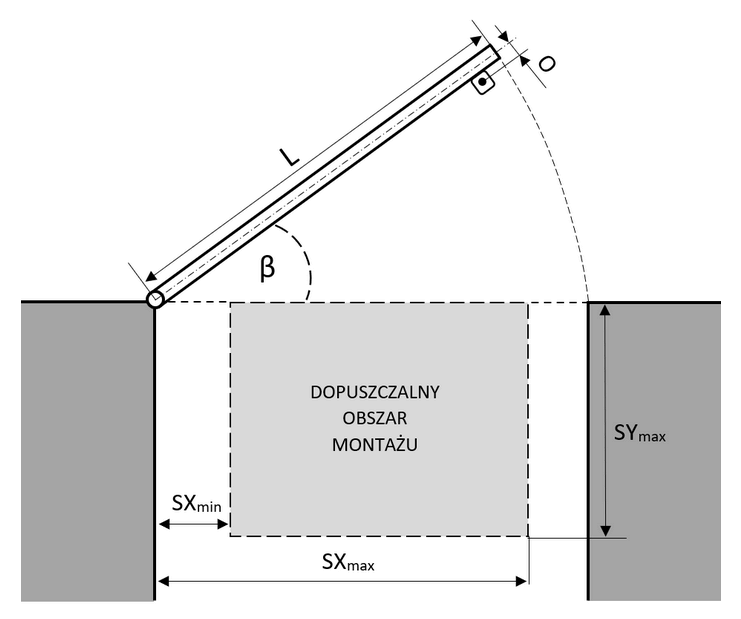
We are pleased to present a tool that does all the calculations for you! Your role will only be to provide the data that our calculator needs, i.e.:
- Hatch length L,
- Hatch weight,
- Required hatch opening angle β,
- Determining the amount of space available at the hatch to mount the actuator (dimensions SX, SX, SY),
- Distance from the hole for the actuator pin in the mount on the hatch to the plane determined by the hatch hinge axis O, and
- The maximum force F applied to the end of the hatch, the pressure of which the actuator must withstand.
The described parameters are clearly marked on the drawing below:
You will find the link to the calculator at the end of the article. However, before you click it, read the entire article to easily choose the best solution.
Our tool will do the rest of the calculations for you and provide a solution (if one exists under the assumptions you made). This solution will be one or more proposals of actuators from our offer that will be able to cope with this task.
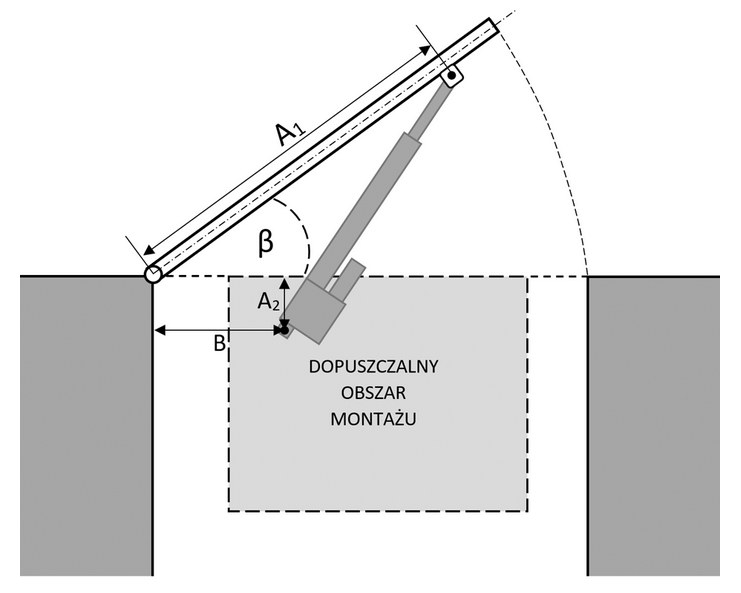
Together with a specific actuator, you will immediately receive a set of installation parameters: dimensions A, A and B from the next drawing. They determine the place where a given actuator must be mounted so that your hatch opens in accordance with the assumptions.
From among the suggested actuators, you will only have to choose the right variant for you, taking into account, e.g., the required tightness of the actuator or the budget you have.
Installation of a hatch actuator
Once you have selected the appropriate actuator and marked the points in space where it is to be mounted, only the mechanical installation remains.
It is worth applying yourself so that it is done carefully and without compromise and saving on material. Especially if the hatch is heavy (falling off the actuator after tearing out too weak mounts could hurt someone), or it is made of glass or other non-cheap material (it’s a pity for additional costs). Therefore, use decent brackets made of suitably thick sheet metal and proper screws to be sure that nothing will break off.
Make every effort to hook the actuator as accurately as possible at the points determined by our calculator. And while we’re on the subject of mechanical installation, by the way, such a small protip: mount the brackets and the actuator on a closed hatch. Why? As a rule, even if you assume some maximum opening angle of the hatch, there is usually still some margin that will allow for a slightly larger opening. However, the hatch can never close further. Therefore, if inaccuracies arise somewhere during installation, you certainly cannot afford them when the hatch is closed. If the hatch closed to the end, and the actuator wanted to go even further, because there was literally a millimeter left to turn off the limit switch, it could turn out that either it would tear the mounts, or such stresses would be introduced into the hatch structure that the tiles would fall off or the glass plate from which the hatch is built would break. Therefore, the maximum closing of the hatch is a critical point that must be done accurately.
Summary
Choosing an electric actuator for a hatch is not an easy task without proper knowledge or tools. By using our calculator, even if you cannot derive the equations that „work” with hatches yourself, you are still able to choose the right actuator quickly and with little effort.
So if you have a hatch to automate, we encourage you to use the tool we provide and to familiarize yourself with the offer of our electric actuators on the elektrobim.pl website.
The Elektrobim offer also includes actuators for furniture, actuators for doors, actuators for windows, but also custom actuators, designed for special tasks.
Check our hatch actuator selection calculator!