
Gate photocells and gate automation – a solution that can make life easier
Is a gate photocell needed? It’s a trick question. For some it is an unnecessary gadget, for others a real „game changer”. Photocells have long been very eagerly used in automatic and security systems – doors, elevators, alarms, barriers. Installing a photocell to an entrance, sliding or garage door will increase the convenience of their use. First, however, it is worth answering the questions: what exactly is a photocell and how does it work, as well as what rules apply when it comes to connecting photocells to the gate? You will learn this from the article.
Table of Contents
- Photocell – what is it? A little general knowledge
- Gate photocell – construction and operation
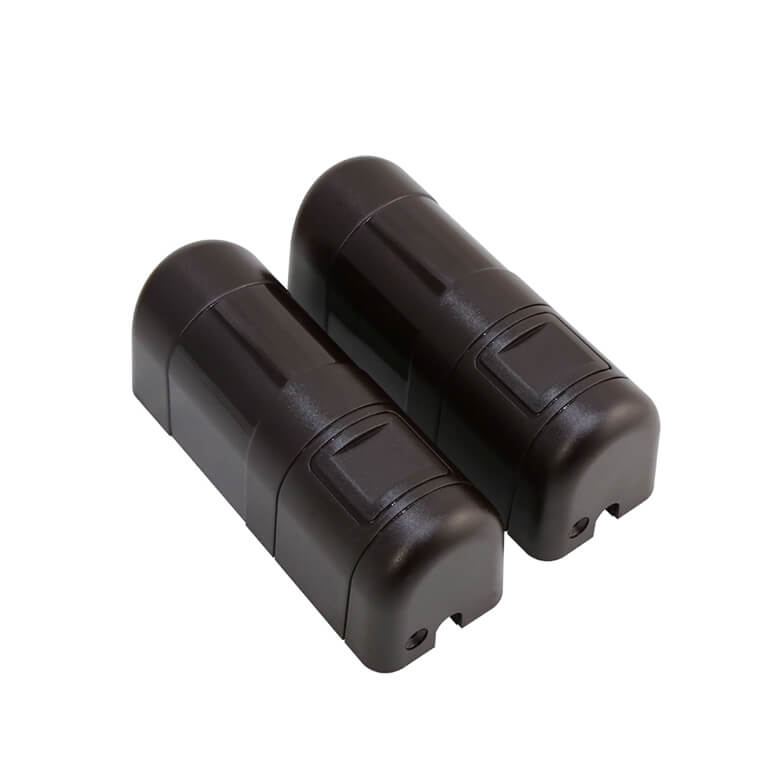
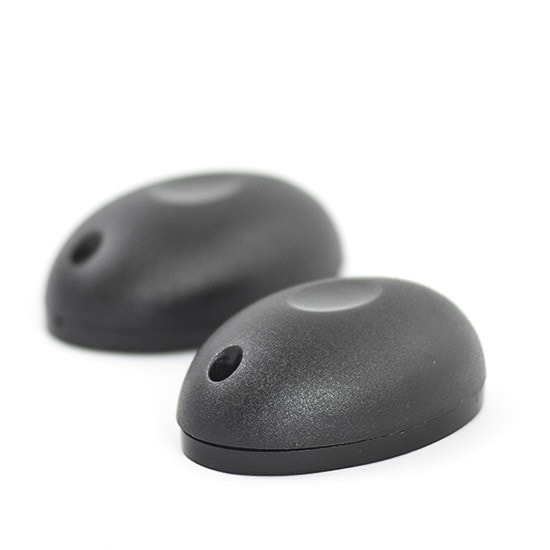
- Types of photocells for gates and fences
- Analog photocell
- Digital photocell
- Wireless photocell
- Installation of a photocell to a double-leaf and single-leaf gate
- Why is it worth installing a photocell?
Photocell – what is it? A little general knowledge
Like any invention, the photocell also has its beginnings, and at their foundation was one of the smallest elementary particles – the electron.
The electron was scientifically defined in 1897, but the first photodiode was created two years earlier as a result of research by German physicists Hans Geitel and Julius Elster. The photodiode, otherwise known as a vacuum tube, consisted of a vacuum bulb and two electrodes placed in it – a cathode and an anode. The anode, bringing current inside the bulb, „attracts” electrons emitted under the influence of illumination by the cathode. In this way, a beam of light invisible to the eyes is created, and in a great simplification, this is the basis of the operation of current photocells.
Gate photocell – construction and operation
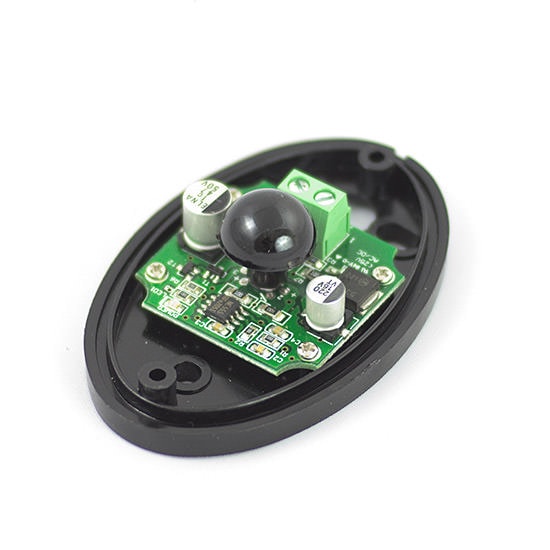
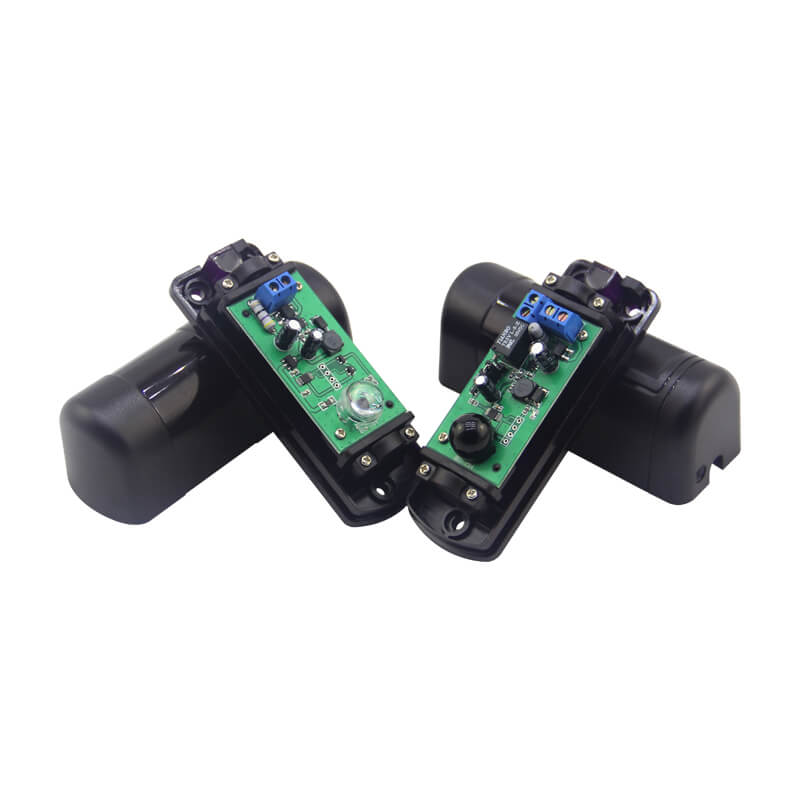
Modern gate photocells consist of two separate parts. For a photocell to properly fulfill its task, it is not enough for the light beam to be emitted. Information about its occurrence or not must reach the drive, and a „receiver” is needed for this.
A standard gate photocell consists of:
- Transmitter – a small electronic board with an IR (infrared) transmitting diode, which, after supplying voltage to the electronic system, sends a signal in the form of a modulated light beam;
- Receiver – slightly more complicated in construction. In addition to a photosensitive element receiving a signal from the transmitter, it has an electronic circuit capable of „recognizing” the proper light beam emitted by the transmitter, and at the output it has a relay with NO or NC contacts (most often used in gate systems).
So how does a photocell in a gate work? Simply put, the transmitter receives voltage and transmits a signal in the form of a properly concentrated beam of infrared light to the receiver. The receiver’s construction makes it react only to the beam emitted by the transmitter, ignoring infrared light from other sources (e.g. the sun). This is possible because the transmitter modulates the transmitted IR light in such a way that the photosensitive element in the receiver knows which beam to react to.
If nothing interferes with the reception (the beam is not interrupted), the mechanism closes or opens the gate. The moment an obstacle appears in the path of the beam, the photocell receiver receives information that the movement of the gate must be stopped and transmits it to the drive control panel via the output relay contact. In such a case, most often the gate leaf not only stops, but even begins to retreat.
Types of photocells for gates and fences
What kind of photocell it is depends primarily on how information about an obstacle is transmitted from the receiver to the control panel. It also depends on how to connect the photocell to the gate. There are two main types – analog (classic/relay) and digital (relayless).
Analog photocell
This is a standard type of photocell, whose main construction feature is the presence of relays. They are responsible for switching on or disconnecting the circuit if the signal from the transmitter does not reach the receiver. Connecting a photocell to the control panel is also more complicated here, because it requires more wires.
Digital photocell
The difference between a digital and analog photocell is the lack of relays. The beam interruption signal is sent digitally via the same wires that supply power. It must be remembered that a digital photocell can only be connected to a device that will be able to properly decode the digital signal. A big plus, however, is the method of connection with the control panel – literally two wires are enough for this.
Wireless photocell
And here’s a surprise – it is not wireless at all. Or at least not completely. So where does this term come from? The reason lies in the transmitter. In standard sets of photocells, to connect the transmitter, you need to route wiring along the gate. A wireless gate photocell has a transmitter that is powered by a battery or accumulator. Thanks to this, you do not have to disturb the driveway to pull cables under it. However, as with any solution, there is a certain difficulty – you must remember to replace the batteries or recharge the accumulator. And you can’t connect cables to it. Wanting to change the type of photocell, you have to replace the whole set.
Reflective photocell
On the market you can also find a solution such as a reflective photocell. What is interesting about it is that the transmitter and receiver are built into one device, which is mounted on one side of the gate, and an appropriately set mirror (reflector) is installed on the other. How does it work? As in the case of standard photocells, the transmitter emits a modulated light beam. The difference, however, is that it does not reach the receiver directly, but reflects off the mirror on the opposite side of the gate. And only this reflected ray returns to the device in which the receiver is located. Such a solution is most often used when we want to automate a gate that protects a driveway that has existed for years. To connect the photocell, you do not have to tear it off, dig under it and lay it anew. However, like any solution, this one also has its downsides. The biggest one is that the mirror (reflector) must be spotlessly clean to properly reflect the beam.

Installation of a photocell to a double-leaf and single-leaf gate
Mounting a photocell to a gate depends primarily on its type. The biggest challenge here is really routing the wiring to the transmitter and receiver in the case of an analog photocell. It should also be remembered that for the set to work properly, the transmitter and receiver must be at the same height (in the same horizontal line). It is recommended about 40-60 cm above the ground. Of course, the elements must be mounted on opposite posts and directed towards each other so that the beam between them forms a line parallel to the gate.
Another issue to pay attention to is the type of gate. 1 beam line is enough for a sliding gate. Installation of a photocell to a single or double leaf gate includes 2 lines. One should run just in front of the closed leaves, and the other at most half a meter behind the open leaf. Breaking the first beam will open the gate. The second one is to work in two cases. The basic one is to ensure that the gate does not close too early, and the user manages to disappear from its firing range. The second, less obvious, is the situation when the beam is broken while the gate is opening. In this case, the leaf will also be stopped and will not hit the obstacle.
Connecting a photocell is not very complicated and with the help of the instructions you can easily do it yourself. However, if someone does not feel up to it, they can use the services of a professional service. For example, the services of our specialists from Elektrobim.
Why is it worth installing a photocell?

Uncomplicated construction as well as effective and practical operation, regardless of weather conditions, are the main advantages for which it is worth installing photocells for the gate. By mounting them, we automate the operation of the gate, and thus increase the convenience of its use. However, the greatest asset of this solution is the issue of safety. The sensitivity of the photocell and the speed of sending information about the obstacle reduce the risk of an accident to a minimum. The user can safely use the gate without fear of getting pinched or scratching the car.
In addition, installing a photocell to the gate also protects the drive. The signal that reaches the control panel causes the drive to stop the leaf or start reversing it. This significantly reduces the risk of overloading the system, and as a result, its failure.
To sum up – connecting a photocell to the gate is an extremely beneficial and cost-effective decision. The appearance of the gate does not lose out, and the convenience and safety of use significantly increases. Installation is also not a major problem, and in case of any questions or doubts, Elektrobim is always ready to help.